


Update: Meshtastic / CRISiS Lab meeting
Thursday 26 March – Upstairs in the Eastbourne Hub/Library, 38 Rimu Street, Eastbourne, Lower Hutt
Migada Perera and Raj Prasanna from the CRISiSLab team – based in the Joint Centre for Disaster Research (JCDR) at Massey University will be there to describe the system, hand over devices, give guidance on how to use them, and answer any questions. In essence you will receive a small transceiver unit and will need to install a Meshtastic app on your mobile phone to control it.
The Eastern Bays can be easily isolated from each other as well as the Hutt City with only one road in which also carries our utilities. We are also sandwiched between the sea and hills, vulnerable to extreme weather, earthquakes, slips and extreme sea states. We need to prepare to be self sufficient for some days. One of the first victims of disaster is usually communications networks, either through technical failure or just overloading.
Part of our current preparedness is a VHF radio network operated by volunteers in each bay. This system is old, incomplete and still vulnerable, depending on repeaters outside the bays. There are new technologies being introduced that will make this system redundant, and we are unlikely to be included in the new system, so we need to make our own resilient communications network that will continue to operate regardless of utility or other infrastructure failure.
 We are currently trialling a low power radio (LoRa) network called Meshtastic. This basically comprises small digital radio devices that pass message
 s between themselves without relying on any other technology – a mesh network. An analogy is a room full of people communicating by passing notes around. The note could reach it’s destination provided there is someone within reach for each step of the journey. The actual path is not important, and can vary. Messages similar to text messages can be transmitted, but not audio or video.
Channels can be set up, including public channels that anyone can access, or private channels to allow secure communications within a family or rescue team, it can also serve as a non emergency communications option as well.
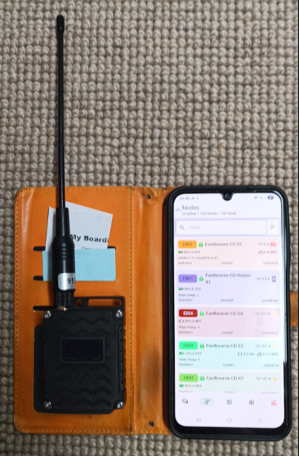 We currently have 4 units and a repeater to trial, but not much progress has been made.
This image shows one of the LoRa units next to a mobile phone for reference purposes. The connection to the phone is via blue tooth (i.e. wireless) so it can be carried separately or just nearby depending on how it is used.
The app displays messages from other units. Messages can be sent to a group or to a single other unit.

CRISiSLab is a research and learning laboratory based in the Joint Centre for Disaster Research (JCDR) at Massey University in Wellington
CRISiSLab is driven by a passion for cutting-edge research and innovation, and their work reflects their unwavering commitment to interdisciplinary collaboration and diverse perspectives. The lab is at the forefront of five ground breaking research themes, including earthquake early warning, citizen science and crowdsourcing, artificial intelligence, communication technologies, and sensor design and development.
The high dependency on the internet for sharing information exacerbates the problem. In disaster-stricken regions, internet connectivity can be disrupted or completely unavailable, further impeding communication and information flow. As a result, there is a pressing need to research alternative telecommunication technologies that can function independently of existing infrastructure. These technologies should be resilient, reliable, and capable of providing communication services in disaster scenarios.
Eastbourne is on a similar journey – this page will document that journey together with support from CRISiSLab.
CRISiSLab are keen to have the Eastern Bays involved in their research – if you are interested in this project, either to participate or just stay informed please get in touch